Using Commercial Free Stock Photos as Part of Art
Disclaimer: The following commodity is meant to assist y'all avoid unpleasant situations when using free photos. Merely it is not intended to be legal advice and so please do not accept it every bit such. I recommend consulting an attorney with any questions.
I think you'll agree with me when I say:
It'southward Really important to avoid legal problems when using images on your website or any other of your projects.
With sites like Unsplash, Pexels, and Pixabay effectually, it is today easier than ever to find free stock photos…
Only, is it really as safe as you think it is to use those beautiful free avails?
Well, equally it turns out, there are a few dangers you need to be aware of.
The good news is that it doesn't take a lot of practice to learn how to identify those dangers and later you lot exercise it in one case or twice, it should become a quick and easy procedure for you to find photos that can be used without worry.
The problem with free stock photos in manifestly English language
What nearly people call back when downloading a gratis photograph is that the only entity with rights to that photo is the photographer who took it.
And it is true that when a lensman uploads a photo to a free stock site like Unsplash or Pixabay, she or he knowingly forfeits all rights to the photograph.
So with the photographer's rights out of the way, there is zip to worry about, right?
Wrong.
Let's say that a photograph is released on Unsplash, arguably the largest site in this space.
At present let's have a await at the Unsplash motto:
Download free (exercise any you want) high-resolution photos.
"Exercise whatever you desire" equally in "employ photos for free, including for commercial purposes, without permission from or attributing the photographer or Unsplash."
Just past looking at that bit of the Unsplash license, 1 can exist led to recollect that any image on Unsplash tin be used for commercial purposes.
If yous remember that too, yous are in dangerous waters!
Why? Because…
A photographer cannot release rights she or he doesn't own
There are several rights that may exist in a photograph that the lensman doesn't necessarily own and therefore cannot release.
Examples of such rights:
- Model rights
- Property rights
- Trademark
- Copyright
In order for a photographer to let you to use a photo commercially, he or she needs to obtain a legal certificate known as a "release" from every rights holder in the photo.
For example, a model release has to exist obtained if there is an identifiable person in the photo. Like so:

Yous may be shocked to know that sites like Unsplash or Pexels or Pixabay or StockSnap, practice NOT collect releases. They trust photographers to merely upload photos for which they have obtained the necessary releases simply they practice not validate the fact.
To be fair, doing so would probably be unsustainable for them from a financial standpoint.
All the same, there are some sites out there that collect releases. Kaboompics is ane of them (according to their own statement) but, as you would look, their paradigm library isn't equally broad.
Without whatever further ado, permit's take a expect at how you can stay on the rubber side.
The 5 questions you need to respond before downloading and using free stock photos
Yes, there are only five.
- Is the license current?
- Is your apply commercial?
- If so, are releases needed and have they been nerveless?
- Are there any copyright problems?
- Are at that place items in the photo protected by trademark law?
Now let'southward accept a closer wait at each i:
1. Is the license current?
It is extremely common for free stock photo sites to source or curate images from ane some other. For example, Pexels states they source images from Pixabay, Gratisography, Lilliputian Visuals as well as other sites.
Now, let's presume a photo is originally uploaded to site A and and then somehow ends up in site B.
The photographer changes his mind about offering the photo for costless and then he takes information technology downward from site A (where it was originally uploaded). Little does he know the photo was also posted on site B.
Everyone who had downloaded the photo from site A earlier the lensman took it down tin can still use it under the license that was valid the moment they downloaded information technology.
But people who download the photo from site B after the photographer takes it downwardly from site A do Non have the right to utilize it.
A scenario like this unfolding is partially why Unsplash now prohibits redistribution of their photos.
What to do
Try to trace the epitome back to the original source (typically the lensman who took it) to confirm the license. I know information technology sounds similar a lot of piece of work only it is the only manner to be 100% certain y'all are legally using the photograph.
For example, I found this one on Pexels:
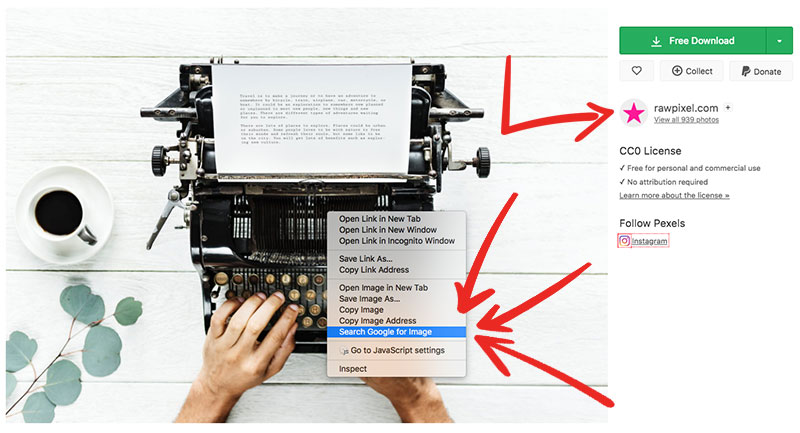
As you can see, this image was added to Pexels by RawPixel.com. I could go straight to RawPixel to confirm the license but I decided to do a Google search for the image first:
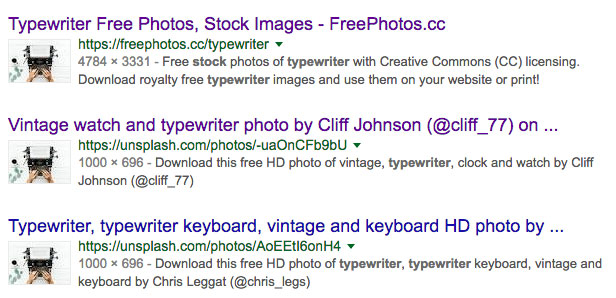
What I found was that aforementioned image was too posted on Freephotos.cc, Unsplash, and Pixabay. The expert news, in this case, is that ALL of those (including Pexels) pointed back to RawPixel.
I took that as a stiff indication that RawPixel is the original source.
Then I visited their site to confirm the image was even so there and then looked at the license.
Equally it turns out, not just is it there but they have a model and belongings release on file for information technology which makes the image perfectly safe to use commercially:

You can see for yourself here.
Now if I had gone back to RawPixel and the image wasn't there, that would be a huge cherry-red flag.
But if everything looks legit when YOU do this, you can go along to the next step and ask yourself the second question.
2. Is your utilize commercial?
NO: yous by and large exercise not have to worry about model and holding releases.
YES: you need to make absolutely sure the needed releases (if whatever) have been collected.
How to tell if your use is commercial
Information technology is more often than not agreed that any activity that sells or promotes, a product, a service, a website, an idea or a conceptfor-profit falls right into this category. Merely with that being said, there is no clear definition of "commercial employ". It can get confusing at times.
If you are non certain, you lot should consult an attorney.
Or yous could just assume your use is commercial (as that is more often the example), steer articulate of using the photograph y'all are looking at (that yous're not sure about) and just carry on to find i that can clearly be used commercially.
If y'all accept adamant your apply is commercial, the time has come up to move to the adjacent question:
three. Are releases needed and have they been collected?
Equally already mentioned, yous practice not need to worry well-nigh model and property releases if your use is editorial.
But if your use is commercial, you demand to exist certain that the photographer has collected all the necessary releases. If you do not see any other style to make sure of that, contact whoever took the photograph and await for their answer.
Most lawsuits happen non because of the photo itself but considering of how it was used. A photographer tin can accept a movie and upload it every bit "free for personal and commercial use" but that does Non mean information technology is suitable for the latter.
So here's what you need to look for in a photo to stay out of trouble…
3.ane Model releases
Is in that location a clearly identifiable person in the photo? If so, yous need to make sure yous accept their consent to use it and therefore you lotneed a model release.
If there are multiple identifiable people in a photo, then you need model releases for all of them.
If there is a person in the photograph merely isnon clearly identifiable and isnot the main subject area of the photo, then y'all practice not need a model release.
Only…
Yous need to exist VERY careful when determining whether or not a person is "identifiable".
A person tin can often be recognized even from the back. A tattoo, a silhouette, a location, a birthmark or a combination of different elements – all can assistance identify a person.
For example, yous would need a model release to use EITHER of the post-obit two photos:

The woman's face is only partially cutting off from the picture but even if we couldn't see her face up at all, the tattoo on her arm would probably be more than than plenty for some people to recognize who she is and therefore, a model release is needed.
That is not the case with a photo similar this one:
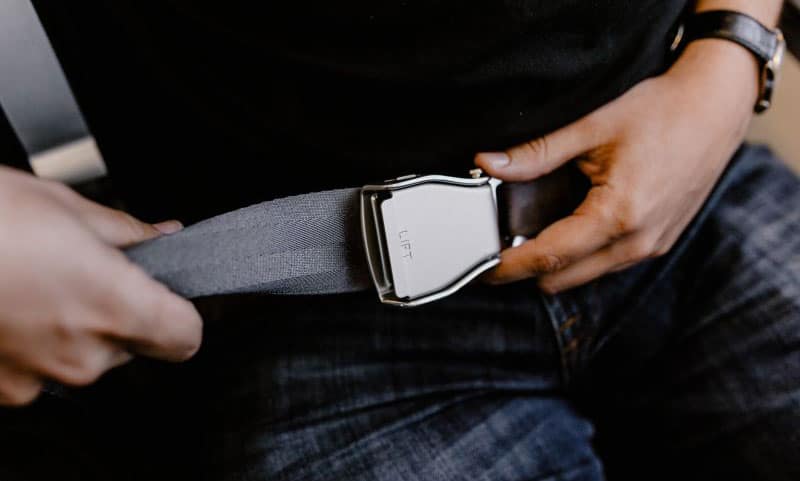
The person in this photo is difficult to identify which makes the above photo safe to use for commercial projects without having to have a model release.
As you can meet, in that location is a good corporeality of subjectivity in play.
Model releases are as well needed for photos of children but in this case, information technology is a parent or a legal guardian signing the release.
iii.two Holding releases
People own so many things: businesses, houses, apartments, cars, works of art, pets, you name it. If a photo is taken on private property or features private property, then a property release is needed to use the photo commercially.

There are two things that are undeniably true almost the to a higher place photo:
- That is a beautiful puppy
- You lot practise not need to await for a property release because information technology is a picture of a street dog without an owner
Just if this pup was lucky plenty to accept an possessor, the photographer would have to have secured a belongings release (signed by the puppy'south owner) in order for yous to download and use the photo commercially.
The American Order of Media Photographers (ASMP) states that they have never seen a statute or legal instance that requires a belongings release. Nevertheless, they practise recommend photographers getting holding releases because the fact is there is legal basis to base a lawsuit on for the lack thereof.
Let'due south say you discover a free photo of a firm that belongs to me and that the photographer who took information technology never bothered obtaining a holding release.
Now you want to use the flick of my house to create flyers that include a slogan that I find offensive.
I happen to see those flyers and I go ahead and sue you considering I do non want to be associated with that slogan of yours. I would debate that my reputation has been damaged because many people saw the ad, recognized my house, and thought I was endorsing you. Non to mention yous made money past using a picture of my belongings without permission.
This may audio far-fetched but it tin can theoretically happen.
Holding releases besides need to exist secured if a photograph is taken on privately held belongings like stadiums, airports, museum interiors, art galleries, shopping malls, motion picture theaters, aquariums, resorts, amusement parks, zoo parks etc.
The same holds truthful for spaces hosting events similar airshows, fashion shows, concerts, and more.
Hopefully, y'all've sorted property releases by now and it is time for the next question…
iv. Are there any copyright issues?
The photo itself has a copyright simply photographers give up on that when they upload their paradigm for distribution under CC0. But when deciding on whether you should use any photo, it is of import that you lot look for elementswithin the photo itself that could atomic number 82 to copyright infringement.

In the above-shown photo, can yous tell which volume this woman is reading?
The respond is no and that is exactly how it should be. You want to steer clear of free photos with identifiable intellectual property such as books and posters on the wall.
With copyright out of the way, y'all're set up to motion on to the fifth and last question:
5. Are in that location items in the photo protected by trademark law?
A trademark is a unique and distinctive marker used to distinguish the products of one party from those of others. Companies have their trademarks very seriously – yous should under no circumstances utilise a complimentary photograph that contains trademarked material within information technology.
Amongst other things, you can be accused of trying to making information technology seem similar they're endorsing your product or service.
Run into to it that branding is removed from any items present in the photo.
Hither are a few examples of complimentary photos that could potentially go you into serious problem if you lot were to use them commercially (if there are no releases on file):
Instance 1
Example ii
Example three
But company logos aren't the merely trademarks you lot should be aware of.
Many buildings are protected by trademark police as well. Here are just some of them:
- The Chrysler Building
- The NY Stock Substitution
- The Transamerica Pyramid
- The Eiffel Tower
What this ways is that you can't download a photo of the Chrysler Building and employ it in an advertising. Again, the principal trouble is that doing so would brand it seem like you are endorsed past the Chrysler Building and that is a big no-no!
Wrapping it all upward
Free stock photo sites have taken the Net by tempest. Whether that's generally a expert or a bad thing is debatable in my apprehensive opinion. Simply that is some other story.
We can all agree that they are, indeed, a major convenience for a lot of people.
Merely gratuitous stock photos can just equally easily become a major inconvenience and go yous into trouble if yous do not know what you're doing.
What virtually you?
Were you aware of these (potential) issues with free stock photos when it comes to commercial use?
Let me know in the comments below!
Source: https://friendlystock.com/avoid-get-sued-using-free-stock-photos/
0 Response to "Using Commercial Free Stock Photos as Part of Art"
Post a Comment