what changes have been made to the second amendment
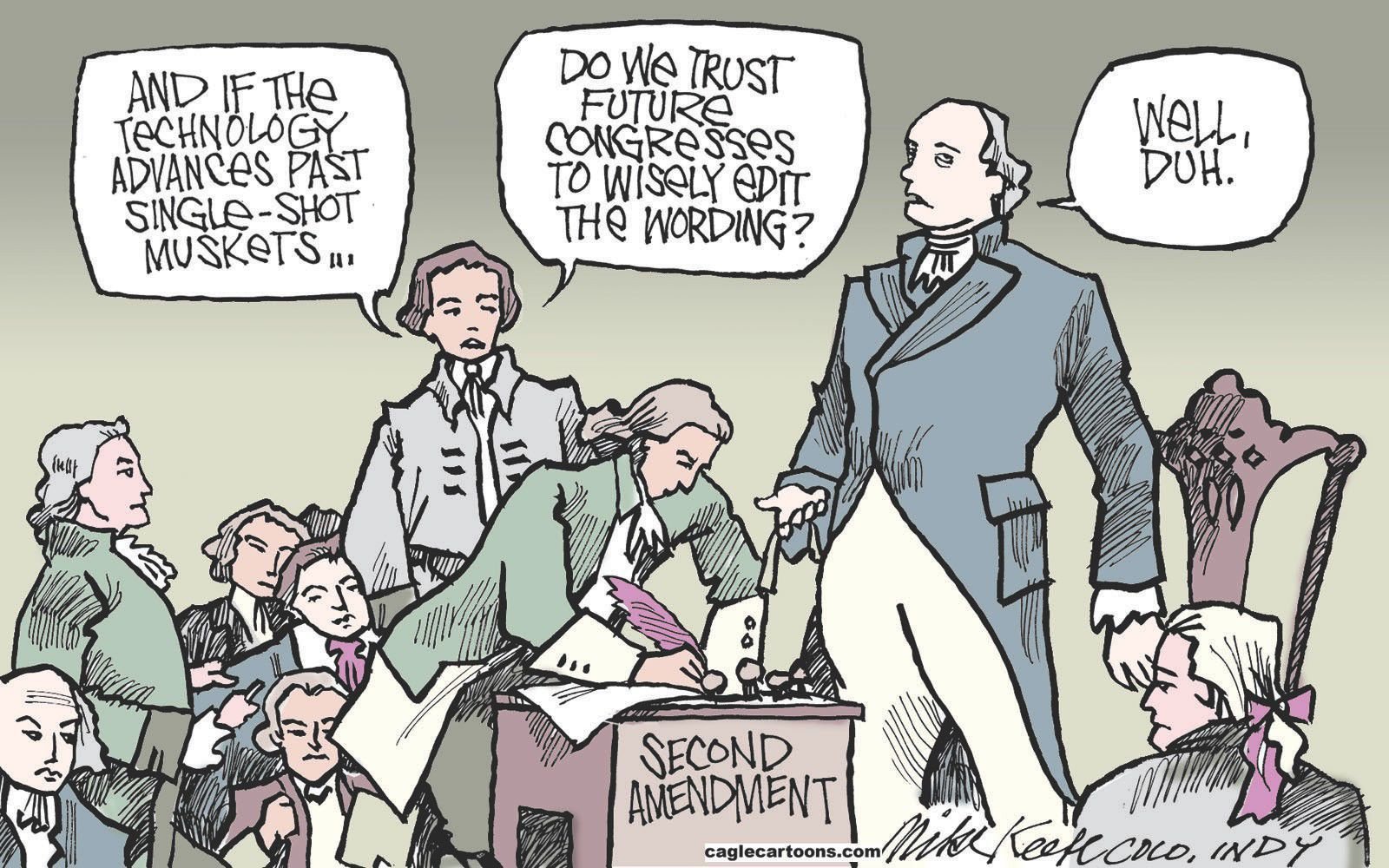
We argue so vociferously about the pregnant of the 2d Subpoena because it doesn't really hateful annihilation any more. We should replace it with a new amendment protecting freedoms that matter to u.s.a. today.
Whenever you choice upwards an commodity virtually gun control — pro or con — yous can be virtually sure of one thing: The author believes that the Second Amendment has a unique and definite meaning, which he or she knows with certainty.
And so the Amendment either clearly supports an individual right to own and utilize guns, or it was intended purely to forbid the federal authorities from disarming state militias (i.eastward., the National Guard). If it does indeed protect an private right, the "arms" we are immune to bear include simply the guns appropriate for defending our homes — which leaves out military weapons — or else the Founders wanted us to have the ways to overthrow the federal government should information technology show tyrannical, making military-course weapons not merely permitted, but absolutely necessary. And so on.
I want to turn that chat upside-down: Our arguments about the Second Amendment are so dogmatic considering we are arguing about shadows in the dark. Each of us projects our own desired meaning onto the Subpoena, considering the 2d Amendment no longer has whatsoever pregnant of its own. With regard to the role of guns in social club, and so much has changed in the last 200 years that whatsoever the Founders intended when they wrote the Amendment is entirely inapplicable to us.
We debate so intensely because there is no answer. We're like heart-aged siblings arguing almost what Dad wants, when Dad has advanced Alzheimer'southward and doesn't know where he is or who we are. Rather than looking at the world as it is and deciding what we desire to practice with it, we sit around a Ouija board trying to contact the ghosts of the Founders — then nosotros complain that somebody else is pushing the planchette rather than letting the spectral vibrations work their will.
How significant gets lost. Any text is vulnerable to having the world change out from under it, and the Founders gave us the power of amendment precisely considering they never intended their words to stand as eternal truths. Is, say, the Start Amendment'south protection of "freedom of speech" intended to protect your correct to set upwardly bots to spread disinformation on social media? What, exactly, was James Madison'south stance on that issue? What would George Washington say virtually using facial recognition software to identify individuals every bit they move through a world whose public spaces are covered by networked surveillance cameras?
Judges make decisions about such issues because they accept to; cases come to their courts and something must exist done with them. And so old laws get encrusted with layers and layers of debatable interpretations. If judges do their jobs well, the public may retain confidence that some "spirit" of the law lives on, fifty-fifty every bit it applies to novel and unforeseen situations.
Only at some point, nosotros demand to take that the original meaning has been entirely lost, and so information technology'southward time to milk shake off the encrustations and reconsider the relevant issues from scratch. That's where we find ourselves with respect to the Second Subpoena. Anyone who says he knows what the 2nd Amendment really means today is either fantasizing or lying, because it doesn't mean anything whatever more.
Consider how dissimilar the earth was when the First Congress wrote the Bill of Rights.
- State militias were the first line of national defense. Political leaders of the Founding era were afraid of the tyrannical potential of a centrally controlled professional ground forces, and imagined that the new nation would have either no army in peacetime or a very small-scale one. [1] That ground forces would grow in wartime, but wars were supposed to be rare, because early American foreign policy intended to avoid "entangling alliances" that would pull the The states into European wars. [2] A country militia (perhaps with help from the militias of neighboring states) would exist adequate to deal with Indian raids, slave revolts, riots, criminal gangs, and other challenges that might occur more oftentimes. In Federalist 29, Alexander Hamilton described a "well-regulated militia" in detail, and judged it to be "the only substitute that tin be devised for a standing army, and the best possible security against it, if information technology should exist."
- Private citizens played a much larger role in constabulary enforcement. American cities wouldn't outset organizing modern police forces until more than than half a century later.
- Guns were single-shot weapons that took time and skill to reload. Modern re-enactors tin reload 18th-century muskets in virtually 15 seconds, bold no ane is trying to interfere with them. An assail like the recent Dayton shooting, in which one man killed ix people and wounded xiv others in half a minute, would take been unimaginable.
- The Beak of Rights did not apply to state and local governments. [iii] Prior to the Supreme Court's Heller determination in 2008, state and local governments could and often did regulate guns. Near a century afterward the Second Amendment, the gunfight at the O.K. Corral was a dispute nigh gun control: The Earp brothers were lawmen enforcing the laws of Tombstone, Arizona, which required visitors to disarm. Many towns in the Old W had some form of gun command. They passed those laws for the same reasons people desire such laws today: Law-abiding citizens should be able to go to a store or to church building or transport their children to schoolhouse without worrying almost getting caught in a crossfire.
Today, we have entangling alliances, fight more than-or-less constant wars, and live in the midst of the large continuing army that the militias were supposed to brand unnecessary. Fifty-fifty pocket-sized towns have professional person police forces, and land and county police forces embrace rural areas. The vast majority of citizens do non at any point in their lives belong to a well-regulated militia. (And no, self-appointed bands of armed yahoos running around in the forest bear no resemblance to the Founders' vision.)
In short, the original reasons citizens needed to exist armed no longer apply, the weapons themselves take changed beyond recognition, and the notion that no one can restrict weaponry is entirely new. Given all that, how can anyone translate the Second Amendment with confidence?
Why mess with it? Currently, both sides deal with the Second Amendment's key emptiness in the same mode: Decide what you want the Subpoena to hateful, and and then try to win elections so that you lot can engage judges who volition pretend it says what you want it to say.
Two things are wrong with this approach. First, it's dishonest and undermines respect for the constabulary. The right manner to change laws is to pass new laws, and the right way to modify the Constitution is to amend it. Each side may claim that it is restoring the "truthful" significant of the Second Amendment. But, as I have argued to a higher place, at that place is no longer any true meaning to recover. The society that gave the Second Amendment its meaning is gone forever.
Second, both sides in this argument need a credible goal, even if that goal is politically impractical at the present moment. The current approach of gun-control advocates (of whom I am i) is, "Can you just give us this much?" And so we ask for groundwork checks or assault-weapon bans or limits on bump stocks or large magazines. All those proposals are very reasonable, merely even in combination they are non a solution to America'south gun problem. So even if those restrictions become constabulary, sooner or subsequently we'll be back to ask for more than.
This smallball strategy plays into the NRA'southward slippery-slope argument, which claims that the ultimate unspoken goal is consummate confiscation. I know of very few people who advocate complete confiscation, even in private. Simply as long every bit the gun-control motion has no stated goal, the NRA has complete liberty to assign us whatsoever goal most frightens its members. The response "No, I just desire background checks" isn't credible, so gun owners who want to protect any gun rights at all will want to agree the line.
Conversely, the NRA'southward strategy of disrupting whatsoever potentially political conversation about guns — it opposes even studying the public-health implications of widespread gun ownership, likewise as developing engineering science to make guns safer — is similarly untenable and provokes similar paranoia on the left: They won't be satisfied until we're all dodging bullets every day.
On each side, rewriting the 2nd Subpoena is a worthy goal. It volition force gun control advocates to grapple with the question of confiscation, and challenge gun-rights advocates to justify exactly which rights are worth protecting and why. The conversation about what the 2nd Amendment ways can never reach consensus, because there is no meaning to converge on. But a conversation about what information technology should say has more potential.
The remainder of this article describes and justifies my own effort to rewrite the 2nd Amendment.
What rights don't demand constitutional protection? To exist perfectly edgeless, a lot of the reasons people want to own guns are frivolous. Those reasons might be perfectly fine in their own means, merely they don't rise to the level of a right that needs constitutional protection.
Guns, I admit, are very clever mechanisms; they even tin can exist said to accept a certain kind of beauty. So I understand why someone might desire to own a collection of them, simply as someone else might collect the pocket watches of diverse eras. Simply the Constitution doesn't protect whatever other collections; it shouldn't protect this one either..
Similarly, target shooting is a worthy sport. It demands skill and concentration. Some people are particularly gifted at it, just every bit some are gifted at pole-vaulting or throwing footballs. But if a community decides that public safety demands restricting this sport, so exist it. Ditto for the sport of hunting. It may exist traditional and so along, simply it'southward a sport. Baseball is also traditional, and raises similar sentiments well-nigh passing downwardly interests from begetter to son. But my correct to play baseball should non exist enshrined in the Constitution, and neither should hunting.
What about overthrowing a tyrannical regime? Then we come to the most contentious outcome: resisting or overthrowing the government, should it plough tyrannical. A disarmed populace, according to this argument, is the precondition for tyranny, and gun control is oftentimes a precursor to taking away other rights.
The are a few things to notation nigh this indicate: First, if y'all believe that an unarmed populace is an invitation to tyranny, I have two suggestions: Reconsider the history you call back you know, and go visit holland. The Dutch have merely 2.six weapons for every 100 people (compared to our 120), and very strict gun-control laws. They also have a college democracy index than nosotros do: 8.89 to our 7.96.
Second, if retaining the power to fight the government is the justification for the right to comport artillery, and then it's hard to argue for any restrictions on armaments at all. Reddish State founder Erick Erickson made this explicit:
You may recollect a thirty round magazine is as well big. Under the real purpose of the second subpoena, a 30 round mag might be also pocket-size.
Indeed, if my purpose in owning guns is to preserve my pick to bring together a Red Dawn resistance and fight the U.Southward. Army, then I need a lot more than but an AR-15. I demand grenade launchers and anti-tank weapons and shoulder-fired Stinger missiles that can have down helicopters (or airliners as they take off or land).
Do you really desire to become in that location? I don't. As much as I fear the current assistants, I'd rather have my chances with the American government than get on a aeroplane knowing that Stingers are available at Walmart.

And that leads to what I encounter every bit the biggest problem with this vision: In the NRA fantasy, the American people are unified in their resistance to a roughshod cabal at the top, and must fight to restore democracy. Second Amendment proponents like to think about the Minutemen or the French Resistance in Earth War 2. Only those aren't the most likely scenarios.
You know what's much more than likely? A violent minority tries to impose its will on the rest of u.s.a. through terrorism. That, in fact, is what we're seeing now from armed white supremacists like the El Paso and Pittsburgh shooters. Their trouble is that they don't represent the American people and and then they can't accomplish their white-homeland vision through the democratic procedure. That's why they need guns.
 The US has seen this pattern in the by as well. The Atlantic'south Mark Nuckols offers two examples:
- Haemorrhage Kansas of the 1850s, where pro- and anti-slavery marauders tried to drive each other's supporters out of the territory.
- The post-Civil-State of war Southward, where the KKK and other white-supremacist groups terrorized blacks out of voting. The resulting white-supremacist governments somewhen disenfranchised blacks legally and instituted Jim Crow.
In short, the situation we accept now, in which a decreasing minority of people owns an increasing numbers of guns, doesn't secure our democracy, it endangers our republic. [iv]
The right to self defense should exist protected from federal interference. So far it sounds like I'm making a confiscation statement, because I haven't identified whatsoever type of gun-buying that deserves constitutional protection. Simply I believe self-defense qualifies on a number of grounds:
- Self-defense is a fundamental human right. If someone attacks you lot, you shouldn't have to just stand there and die. Depending on the severity of the attack, you may be justified in using lethal force. Few things are more horrifying than the idea that someone is coming for you or your loved ones, simply at that place'southward nothing you can do about it.
- Americans broadly believe in a right to self-defence, whether or not they personally ain weapons or get self-defense training.
- Despite the risks that come up with gun ownership, many people take in fact driven off or captured or killed attackers past using their own guns. The risk/reward balance of owning a gun varies from place to place and individual to individual, and so judgments nigh it should not be made on the federal level.
Some of these considerations also apply on the metropolis and land level, so the federal regime shouldn't forbid a lower-level authorities from equipping a force to defend the public safety or enforce the laws.
That said, at that place are some legitimate roles for the federal government to play. Cocky-defense is not an open door for any kind of weaponry at all. No i needs a tank or a nuclear bomb to defend their home or person, or to drive coyotes away from their sheep. Likewise, no one needs an assault rifle with a 100-round magazine or an arsenal with dozens of weapons. A closer analysis of what ways of self-defence force might be necessary in i place or some other is better done at the state level, just the federal regime should exist able to make some wide restrictions.
Additionally, states that want to control guns more tightly demand protection against their laws being undermined past neighboring states with looser laws. So in addition to its full general power to regulate interstate commerce, the federal authorities'south power to regulate, police, or completely ban the interstate transportation or sale of firearms should be spelled out.
A few final considerations. The Constitution sets upward a federal government whose powers are limited to those expressly granted. [5] Merely history has shown that the authorities can leverage the powers the Constitution grants to wield other powers that it doesn't grant. A relatively harmless case was the 55-MPH speed limit fix in 1974 equally an energy-conservation mensurate. The Constitution doesn't grant any speed-limit-setting powers to Congress, so information technology passed a police that denied federal highway funds to states that didn't enact a 55-mph limit. Before the Supreme Courtroom struck it down, the Affordable Care Act'southward Medicaid expansion was some other attempt at using federal funds to force state activity.
So any amendment that limits federal power to regulate guns, but allows state and local powers more extensive powers, should also guard confronting federal coercion of u.s..
Conversely, the federal government needs the power to regulate anything that otherwise would work around restrictions it tin legally make. Then, for example, if Congress can ban automated weapons, it should also exist able to ban kits for converting semi-automated weapons to fully automatic ones.
What should it say? Hither's my proposal:
1. The Second Subpoena to this Constitution is hereby repealed.
two. Congress shall make no law preventing individuals from securing adequate means to defend their homes and persons, or preventing state or local governments from equipping police forces acceptable to enforce their laws and ensure public condom.
3. Congress shall have the power to regulate the interstate transportation and sale of weapons, armament, and other weapon-related items.
4. States shall take the power to regulate the use, manufacture, ownership, and transfer of weapons within their borders, or to delegate such powers to local governments.
5. No federal expenditure or regulation shall exist contingent on a country or local authorities using its ability to regulate weapons in a manner specified by federal police force.
What does it mean? Several things:
- In order to pass a gun restriction, Congress would need to institute that individuals even so accept the means to defend their homes and persons. And so Congress could ban assault weapons, but not handguns. Information technology could limit the size of your arsenal, but non disarm you completely.
- More detailed gun laws would take to be passed at the state level, so states could implement wildly divergent visions. If Texas believes that guns-everywhere makes the public safer, it can try that. But if Illinois wants to allow Chicago ban guns completely, it can try that too. People who feel unsafe in one state or the other don't have to go in that location. (Texans who come to Chicago would take to check their guns, just equally they would have when entering Tombstone.) Colorado might decide to allow a wide range of guns, but regulate guns and their users in a similar way to cars and drivers. This state-past-state diversity would be salubrious; we would see clearly what does and doesn't piece of work.
- State and local governments would go along the power to enforce their own laws, and would non have to depend on a federal force. This was one of the chief tyranny-restraining pieces of the Founders' vision, and one of the few implications of the Second Amendment that notwithstanding makes sense today.
Or write your ain. The main advantage my subpoena would have over the electric current Second Amendment is that it would mean something, independent of everyone'southward hopes and fears. As a issue, both sides could have more confidence about its estimation. We could lessen the paranoia that now attends every presidential ballot or Supreme Court nomination.
The choices I have made are far from the merely ones possible. I accept left a lot of decisions to the states; yous may wish to have a more uniform policy beyond the land. I accept immune outright bans on the local level; you lot may not want that. I have left room for interpretation by using the word "adequate" rather than spelling out exactly how I await future generations to defend themselves. And so on.
But if yous write your own version and we each promote our favorite, await how the word has changed: We are no longer arguing about something unknowable, such equally what was in the minds of people centuries agone, or what they would want if they could meet us now. Instead, we are arguing well-nigh the world we live in and what nosotros want for our future. Anyone tin participate in that discussion by drawing on their own experiences; yous don't have to be (or pretend to be) a historian or legal scholar.
That is a conversation that has potential for growth and change and compromise.
Conversely, no one who considers the contempo history of 2d-Subpoena interpretation should have any confidence that they know what it volition "mean" a generation from now. The Supreme Court'southward electric current estimation was considered a fringe position a generation ago. [6] Unless we replace the Amendment with one that has clear pregnant to people of our era, no 1 can say what ideas on the fringe today might be ramble doctrine tomorrow.
[1] After the Treaty of Paris concluded the Revolutionary War, the Continental Army was reduced to a single regiment of about 700 men stationed on the western borderland.
[two] President Washington said in his Farewell Address:
Europe has a fix of primary interests which to u.s.a. accept none; or a very remote relation. Hence she must be engaged in frequent controversies, the causes of which are essentially strange to our concerns. Hence, therefore, it must be unwise in u.s.a. to implicate ourselves past artificial ties in the ordinary vicissitudes of her politics, or the ordinary combinations and collisions of her friendships or enmities.
[iii] In general, constitutional restrictions didn't utilize to the states until the 13th, 14th, and 15th amendments were passed after the Civil War. The 14th Amendment says:
No land shall brand or enforce any police which shall abridge the privileges or immunities of citizens of the Usa; nor shall any state deprive any person of life, liberty, or property, without due process of law; nor deny to any person inside its jurisdiction the equal protection of the laws.
Over time, the Supreme Court came to interpret "liberty" to include the rights described in the Neb of Rights. This doctrine is known as the "incorporation of the Nib of Rights". The incorporation of the Second Amendment wasn't fully recognized until 2010.
[4] People who are honestly worried about the time to come of American democracy should focus instead on making it work: End gerrymandering and voter suppression. Limit the influence of big-money donors, corporate lobbyists, and hostile foreign governments.
As long every bit the American people retain the ability to vote out governments that don't serve their interests, the resort to guns won't exist necessary.
[5] For this reason, in Federalist 84, Alexander Hamilton argued against including a Beak of Rights in the Constitution considering he believed it would be unnecessary.
For why declare that things shall not exist done which there is no power to do? Why, for case, should information technology be said, that the liberty of the printing shall not be restrained, when no power is given by which restrictions may exist imposed?
[6] Every bit Jeffrey Toobin writes in the current New Yorker: "The Court changed the Second Amendment, and the Courtroom can change it dorsum once more." But unfettered by a text with any actual meaning, information technology could also go somewhere else entirely.
UPDATE
I was kind of overwhelmed past the quantity and negativity of the comments, so I decided not to answer them one by one. Instead, I wrote a sequel that summarizes a lot of the points commenters made and answers the ones that seem to need or deserve answering.
Source: https://weeklysift.com/2019/08/19/how-should-we-rewrite-the-second-amendment/
0 Response to "what changes have been made to the second amendment"
Post a Comment